The science behind Plan2Skill
A short explanation of how we measure learning, why we think it matters, and which work we build on.
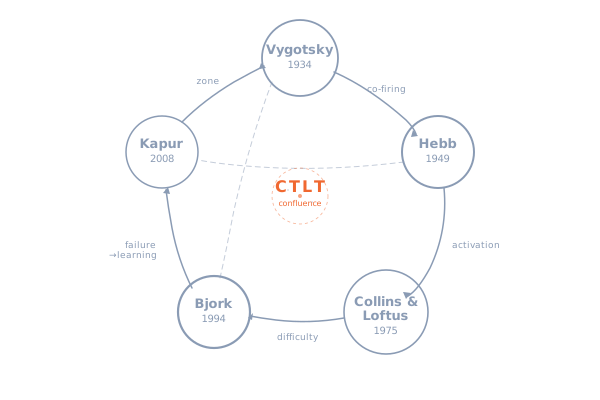
Cognitive Topological Learning Theory (CTLT) is a learning framework that measures edges — connections between concepts — rather than nodes (isolated facts). It synthesises five established research traditions: Vygotsky's Zone of Proximal Development, Hebb's co-activation rule, Collins & Loftus's spreading activation, Bjork's desirable difficulty, and Kapur's productive failure. The name is ours; the science is theirs.
Most learning apps measure what you know — words memorised, lessons completed, streaks maintained. They count nodes. Plan2Skill measures something different: the connections between what you know. We count edges.
Here is a simple example. You learn that Spanish "tener" means "to have." That is a node. Then you learn that "yo tengo" is the first-person form — and that "tener" changes its stem in ways most -er verbs do not. Now you have an edge: a connection between the word, its conjugation, and the rule that makes it irregular. That edge is where fluency lives.
The same principle holds outside languages. In physics, knowing Newton's second law (F = ma) is a node. Knowing when to apply it instead of conservation of energy — and why one works better in a particular problem — is an edge. In programming, knowing what a SQL JOIN does is a node. Knowing when to use LEFT JOIN vs INNER JOIN for a specific data shape is an edge.
IIThe theories we build on
CTLT does not emerge from a single paper. It draws on a quiet consensus across five decades of cognitive-science research. Each of these theorists identified a piece of the same puzzle — that learning is not about accumulating isolated facts, but about building and strengthening connections between them.
- Lev Vygotsky — Zone of Proximal Development (1934)
- Learning happens in the gap between what a learner can do alone and what they can do with guidance. CTLT maps this gap as unmapped edges adjacent to existing strong ones.
- Donald Hebb — Co-activation rule (1949)
- "Cells that fire together, wire together." Repeated co-activation strengthens neural pathways. CTLT treats edge weight as a proxy for Hebbian consolidation.
- Allan Collins & Elizabeth Loftus — Spreading activation (1975)
- Knowledge is a network; activating one node spreads to connected nodes. CTLT builds on this by making the network visible and measurable.
- Robert Bjork — Desirable difficulty (1994)
- Conditions that make learning harder in the short term (spacing, interleaving, testing) produce better long-term retention. CTLT uses edge difficulty as a feature, not a bug.
- Manu Kapur — Productive failure (2008)
- Students who attempt problems before receiving instruction learn more deeply. In CTLT, wrong answers still draw edges — as weaker, dashed connections that signal where to return.
IIIOur approach
Plan2Skill builds a cognitive graph for each learner in each domain. Nodes are concepts. Edges are connections between concepts — tested, weighted, and updated after every quest.
When you answer a question correctly, the edge between the relevant concepts strengthens. When you answer incorrectly, the edge still forms — but as a weaker, dashed connection that tells the system to revisit it. The graph grows with every session, and the system uses it to decide which edges to test next.
We don't publish the recipe — the formulas, weights, and thresholds are our alpha IP. What we publish are the results, the changelog, and every named theory we ground the work in.
IVHow edges form: three worked examples
The distinction between a node and an edge is easy to state but takes a moment to feel. These three examples — one language, one code, one physics — show what it looks like when an edge actually forms.
Example 1: Spanish irregular verbs
Imagine learning Spanish. You memorise that tener means "to have" — that is a node. Then you learn that yo tengo is the first-person form, and that the stem changes from ten to teng in ways most -er verbs do not. Now you have built two edges: one between tener and its conjugation pattern, and another between irregular conjugation and the broader rule of stem-changing verbs.
The first edge (tener → tengo) might form quickly. The second edge (stem-change pattern → when it applies) takes longer and requires encountering other stem-changing verbs like poder → puedo and querer → quiero. Plan2Skill tracks both edges. When the first is strong and the second is weak, the system knows to send you more stem-changing verbs — not more basic vocabulary.
This is the difference between a learner who can recite a rule and a learner who can apply it under pressure. The first has a node. The second has an edge.
Example 2: SQL joins
In programming, you learn that a SQL JOIN combines rows from two tables — that is a node. Then you learn the difference between INNER JOIN (matching rows only) and LEFT JOIN (all rows from one table, with NULLs for the other). That is an edge.
The deeper edge forms when you can decide which join to use for a specific data problem: "I need to find users who have never placed an order" requires LEFT JOIN with a NULL check. The question is not whether you know what a LEFT JOIN is — it is whether you can reach for the right tool without prompting. Plan2Skill maps the progression from knowing what a join does (node) to knowing when to pick the right one (edge) to knowing why one approach outperforms another on a given data shape (deeper edge).
Each step in that chain is a distinct edge in the learner's cognitive graph. A quiz that asks "what does LEFT JOIN return?" tests the node. A scenario that asks "write a query to find inactive users" tests the edge. We design for the second.
Example 3: Physics — Newton's laws
You learn Newton's second law: F = ma. That is a node. You learn conservation of energy: Ekinetic + Epotential = constant. Another node. Both are facts you can state from memory.
The edge forms when you can decide which tool to use for a given problem. A ball rolling down a ramp? Conservation of energy is simpler — no need to track forces moment by moment. A car braking on a surface with friction? F = ma is more direct — friction acts as an explicit force. The ability to choose the right framework for the right problem is an edge between the two nodes.
It is exactly the kind of knowledge that streaks and lesson-completion cannot measure. You can complete a hundred lessons on Newton's second law and still reach for the wrong tool. The edge only forms when you have been put in the position of choosing — and been wrong, and then been right.
These examples span three domains — language, code, physics — but the principle is the same. Learning lives in the connections.
VHow we know this works
We are in alpha with ~50 learners. We do not have the sample size or the study design to make causal claims. What we do have is:
- Open metrics published monthly on /metrics — including the numbers that go down.
- A weekly changelog at /changelog documenting every change we ship, every A/B test we run, and every regression we catch.
- A research inquiry channel (research@plan2skill.com) for anyone who wants to stress-test CTLT with their own data or methodology.
We would rather show you small honest numbers than large invented ones.
VIResearchers: write to us
If you work in learning science, EdTech efficacy, or cognitive-graph research and want to stress-test CTLT, research@plan2skill.com is monitored by the team lead. We read every message. We publish substantive exchanges (anonymised, consent-gated) in the changelog.
Pre-print under pseudonym available on request for peer-review citation.
FAQFrequently asked questions
- What is Cognitive Topological Learning Theory?
- Cognitive Topological Learning Theory (CTLT) is a learning framework that measures edges — connections between concepts — rather than nodes (isolated facts). It treats fluency and expertise as properties of the network of connections a learner has built, not just the number of facts memorised.
- What research is CTLT based on?
- CTLT draws on five established research traditions: Vygotsky's Zone of Proximal Development (1934), Hebb's co-activation rule (1949), Collins & Loftus's spreading activation model (1975), Bjork's desirable difficulty (1994), and Kapur's productive failure (2008). Each theorist identified a piece of the same puzzle — that learning is about building connections, not accumulating isolated facts.
- Is CTLT peer-reviewed?
- Not yet. Plan2Skill is in alpha with approximately 50 learners. We do not claim peer-reviewed efficacy we don't have. A pre-print is in preparation for peer-review submission, targeted for Q4 2026. Open metrics are published monthly at plan2skill.com/en/metrics.
- What is edge-based learning?
- Edge-based learning means measuring the connections between concepts, not just the concepts themselves. A node is an isolated fact — knowing that Spanish "tener" means "to have." An edge is a connection — knowing that "yo tengo" is irregular and understanding why. Fluency and the ability to apply knowledge under pressure live in the edges, not the nodes.
VIIFurther reading
Read what we believe, or go back to the map